FOUNDATION for EDUCATIONAL ADVANCEMENT, Inc.
of CONNECTICUT

A B O U T  U S  |  M I S S I O N  H . E . L . P.  |  A C C O M P L I S H M E N T S


Accomplishments

Chronology of Events: 1992-2008

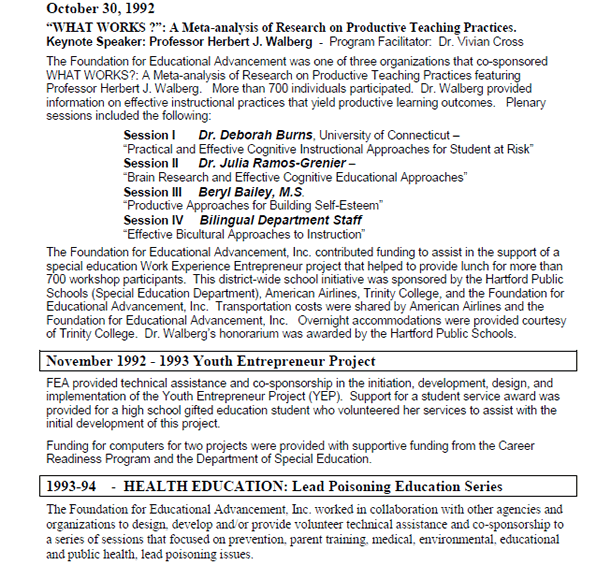
October 30, 1992


“WHAT WORKS ?”: A Meta-analysis of Research on Productive Teaching Practices.
Keynote Speaker: Professor Herbert J. Walberg  -  Program Facilitator:  Dr. Vivian Cross

The Foundation for Educational Advancement was one of three organizations that co-sponsored WHAT WORKS?: A Meta-analysis of Research on Productive Teaching Practices featuring Professor Herbert J. Walberg.   More than 700 individuals participated.  Dr. Walberg provided information on effective instructional practices that yield productive learning outcomes.   Plenary sessions included the following:
 
Session I       Dr. Deborah Burns, University of Connecticut –
“Practical and Effective Cognitive Instructional Approaches for Student at Risk” 
Session II      Dr. Julia Ramos-Grenier
“Brain Research and Effective Cognitive Educational Approaches”
Session III     Beryl Bailey, M. S. 
“Productive Approaches for Building Self-Esteem”
Session IV     Bilingual Department Staff
“Effective Bicultural Approaches to Instruction”

The Foundation for Educational Advancement, Inc. contributed funding to assist in the support of a special education Work Experience Entrepreneur project that helped to provide lunch for more than 700 workshop participants.  This district-wide school initiative was sponsored by the Hartford Public Schools (Special Education Department), American Airlines, Trinity College, and the Foundation for Educational Advancement, Inc.  Transportation costs were shared by American Airlines and the Foundation for Educational Advancement, Inc.   Overnight accommodations were provided courtesy of Trinity College.  Dr. Walberg’s honorarium was awarded by the Hartford Public Schools.

November 1992- 1993 Youth Entrepreneurial Project


FEA provided technical assistance and co-sponsorship in the initiation, development, design, and implementation of the Youth Entrepreneur Project (YEP).  Support for a student service award was provided for a high school gifted education student who volunteered her services to assist with the initial development of this project.

Funding for computers for two projects were provided with supportive funding from the Career Readiness Program and the Department of Special Education.

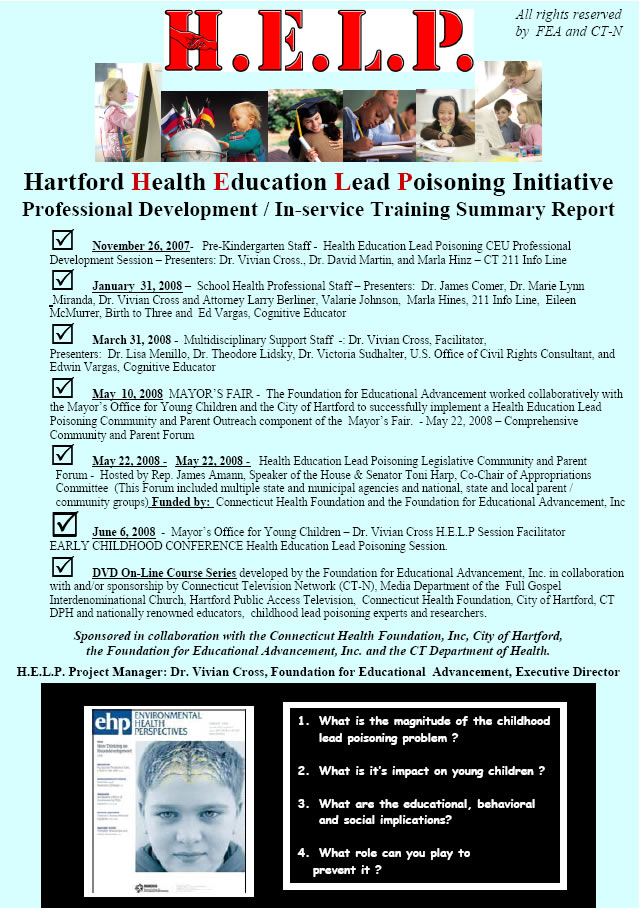
1993-94 -HEALTH EDUCATION: Lead Poisoning Education Series 


The Foundation for Educational Advancement, Inc. worked in collaboration with other agencies and organizations to design, develop and/or provide volunteer technical assistance and co-sponsorship to a series of sessions that focused on prevention, parent training, medical, environmental, educational and public health, lead poisoning issues.

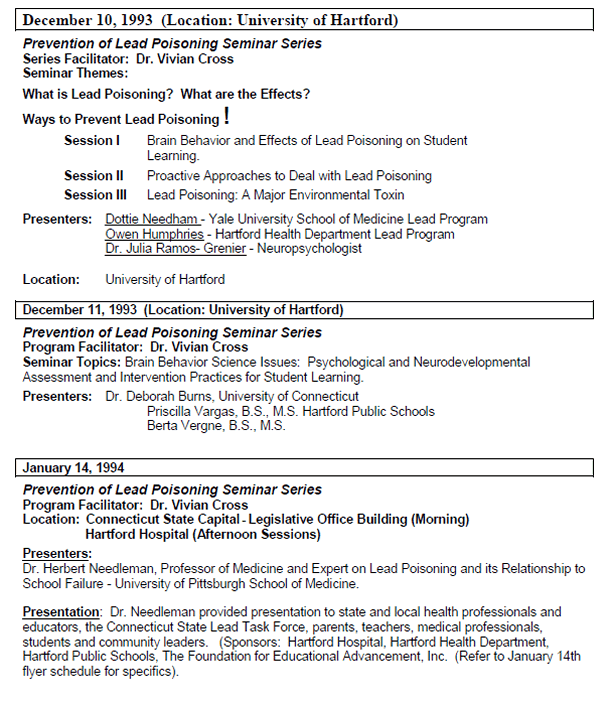
December 10, 1993  (Location: University of Hartford)


Prevention of Lead Poisoning Seminar Series
Series Facilitator:  Dr. Vivian Cross
Seminar Themes:

What is Lead Poisoning?  What are the Effects?
Ways to Prevent Lead Poisoning ! 

Session I        Brain Behavior and Effects of Lead Poisoning on Student
                        Learning.

Session II       Proactive Approaches to Deal with Lead Poisoning

Session III      Lead Poisoning: A Major Environmental Toxin
               
Presenters:   Dottie Needham - Yale University School of Medicine Lead Program
                        Owen Humphries - Hartford Health Department Lead Program
                        Dr. Julia Ramos- Grenier - Neuropsychologist


Location:        University of Hartford

December 11, 1993  (Location: University of Hartford)


Prevention of Lead Poisoning Seminar Series

Program Facilitator:  Dr. Vivian Cross

Seminar Topics: Brain Behavior Science Issues:  Psychological and Neurodevelopmental Assessment and Intervention Practices for Student Learning.
 
Presenters:  Dr. Deborah Burns, University of Connecticut
                                    Priscilla Vargas, B. S., M. S. Hartford Public Schools
                                    Berta Vergne, B. S., M. S.        
           

January 14, 1994


Prevention of Lead Poisoning Seminar Series
Program Facilitator:  Dr. Vivian Cross
Location:     Connecticut State Capital - Legislative Office Building (Morning)                  
                                                 Hartford Hospital (Afternoon Sessions)
              
Presenters:
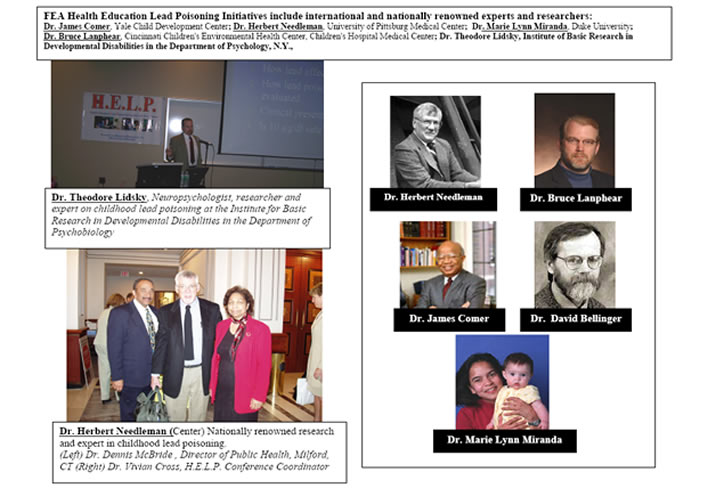
Dr. Herbert Needleman, Professor of Medicine and Expert on Lead Poisoning and its Relationship to School Failure - University of Pittsburgh School of Medicine.  

Presentation:  Dr. Needleman provided presentation to state and local health professionals and educators, the Connecticut State Lead Task Force, parents, teachers, medical professionals, students and community leaders.   (Sponsors:  Hartford Hospital, Hartford Health Department, Hartford Public Schools, The Foundation for Educational Advancement, Inc.  (Refer to January 14th flyer schedule for specifics).


January 15, 1994  (Location: University of Hartford)


Prevention of Lead Poisoning Seminar Series
Program Facilitator:  Dr. Vivian Cross
Presentation:  Attention Deficit Hyperactivity Disorder (ADHD)
Keynote: Dr. Neil Schechter, Head of the Division of Developmental Pediatrics -
St. Francis Hospital and Professor of Pediatrics - University of Connecticut Health Center - Sponsors: St. Francis Hospital, University of Connecticut Health Center, University of Hartford, Hartford Public Schools, the Foundation for Educational Advancement, Inc.


March 8th and 9th (1994)  (Location:  University of Hartford)


    “Unlocking Learning Power for Student Achievement”
 Program CEU Facilitator:  Dr. Vivian Cross        
Presenter:  Dr. Melvine Levine, Neurodevelopmental Pediatrician
             “A Neurodevelopmental Approach to Enhance Student Achievement”  

Focus:   Memory, Attention, Higher Order Cognition, Social Cognition                  
Approximately two hundred (200) participants comprised of multidisciplinary school-based teams of educators and parents from urban, suburban, private and public schools were in attendance.


July 15th, 18th, 26th (1994)


Chapter I Summer Parent Training Program
            Health Education Lead Poisoning Presentation Component
Program Facilitator:  Dr. Vivian Cross
Location:        Fox Middle School
 
Presenters:  Dottie Needham - Yale University School of Medicine
 
                        Owen Humphries - Hartford Health Department Lead Program
 
Mary Margaret-Gaudio - Cooperative Extension System, University of CT
 
                        Ray Alphonso, President - Advanced Lead Technologies
 
                        Dr. Vivian Cross - Facilitator
Overview:
Approximately 45 parents and 10 staff professionals participated in three Health Education Lead Poisoning Prevention Sessions.
           
Sponsors: The Hartford Public Schools Symposium Series, Chapter I Parents Group, Hartford Housing Authority, University of Connecticut Extension Program, Hartford Health Department, Yale University Lead Program, The Foundation for Educational Advancement, Inc.

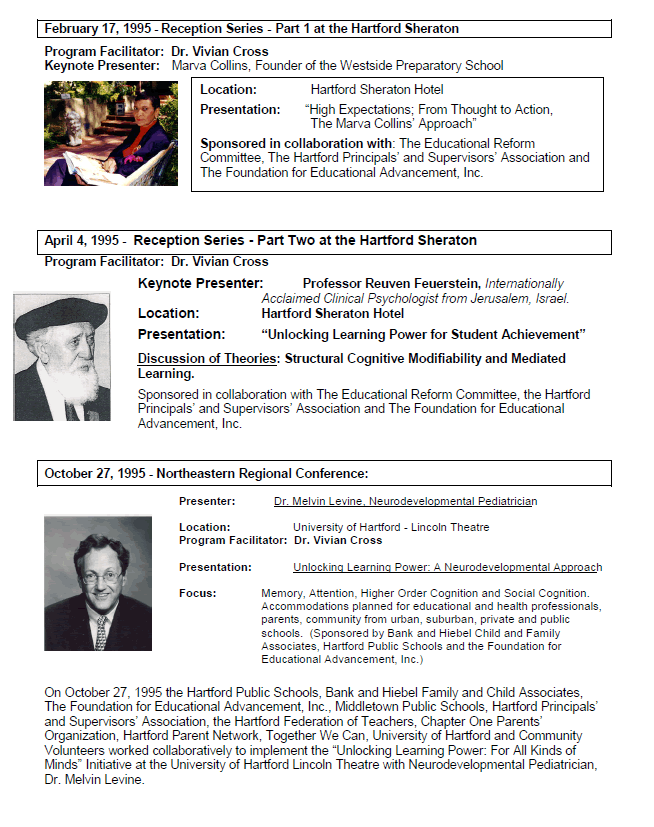
February 17, 1995 - Reception Series - Part 1 at the Hartford Sheraton


Program Facilitator:  Dr. Vivian Cross
Keynote Presenter:               Marva Collins, Founder of the Westside Preparatory School
 
Location:                Hartford Sheraton Hotel
 
Presentation:       “High Expectations; From Thought to Action, The Marva Collins’ Approach”
 
Sponsored in collaboration with The Educational Reform Committee, The Hartford Principals’ and Supervisors’ Association and The Foundation for Educational Advancement, Inc.

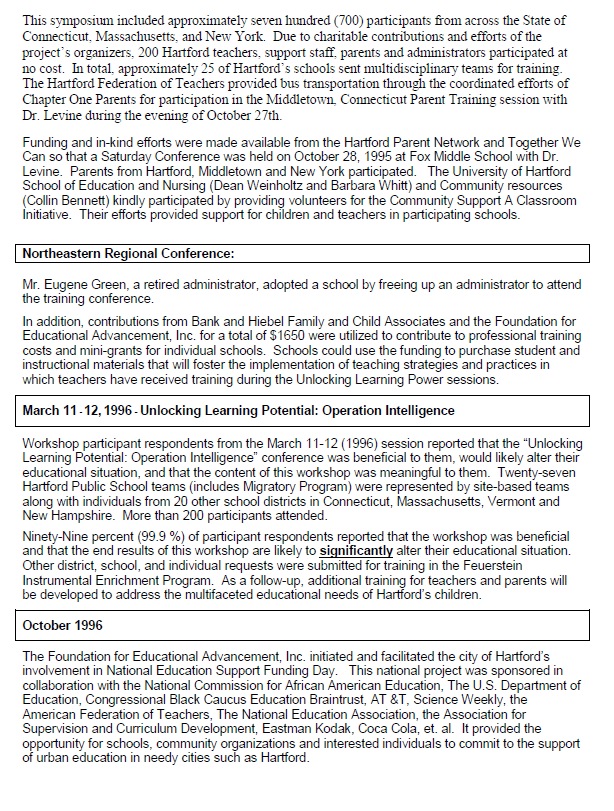
April 4, 1995 -  Reception Series - Part Two at the Hartford Sheraton


Program Facilitator:  Dr. Vivian Cross

Keynote Presenter: Professor Reuven Feuerstein, Internationally Acclaimed Clinical Psychologist from Jerusalem, Israel.
Location: Hartford Sheraton Hotel
 
Presentation: “Unlocking Learning Power for Student Achievement”


Discussion of Theories: Structural Cognitive Modifiability and Mediated Learning.

Sponsored in collaboration with The Educational Reform Committee, the Hartford Principals’ and Supervisors’ Association and The Foundation for Educational Advancement, Inc.


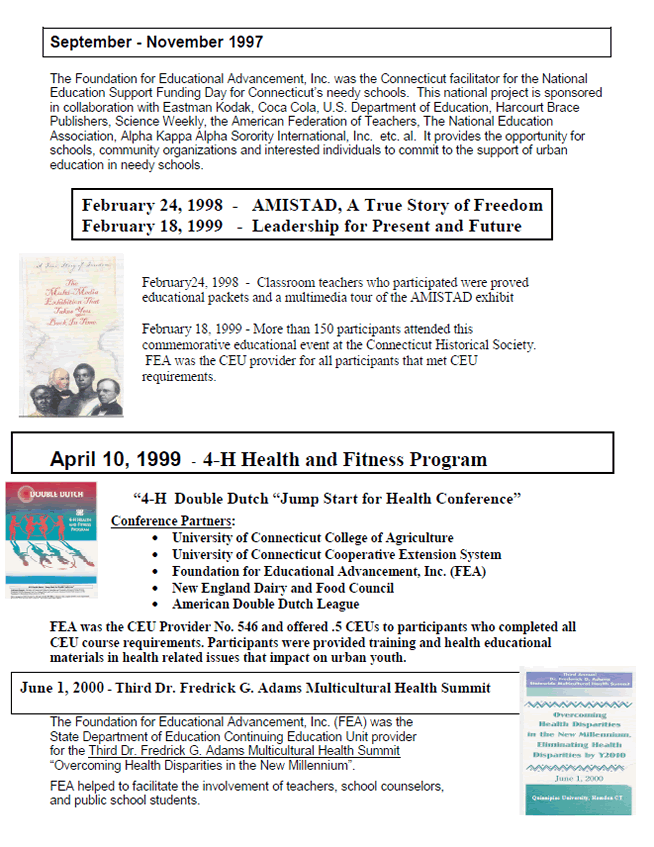
October 27, 1995 - Northeastern Regional Conference


Presenter:                 Dr. Melvine Levine, Neurodevelopmental Pediatrician
 
Location:                    University of Hartford - Lincoln Theatre
Program Facilitator:  Dr. Vivian Cross

Presentation:            Unlocking Learning Power: A Neurodevelopmental Approach
 
Focus:            Memory, Attention, Higher Order Cognition and Social Cognition. 
Accommodations planned for educational and health professionals, parents, community from urban, suburban, private and public schools.  (Sponsored by Bank and Hiebel Child and Family Associates, Hartford Public Schools and the Foundation for Educational Advancement, Inc.)

On October 27, 1995 the Hartford Public Schools, Bank and Hiebel Family and Child Associates, The Foundation for Educational Advancement, Inc., Middletown Public Schools, Hartford Principals’ and Supervisors’ Association, the Hartford Federation of Teachers, Chapter One Parents’ Organization, Hartford Parent Network, Together We Can, University of Hartford and Community Volunteers worked collaboratively to implement the “Unlocking Learning Power: For All Kinds of Minds” Initiative at the University of Hartford Lincoln Theatre with Neurodevelopmental Pediatrician, Dr. Melvin Levine.  

This symposium included approximately seven hundred (700) participants from across the State of Connecticut, Massachusetts, and New York.  Due to charitable contributions and efforts of the project’s organizers, 200 Hartford teachers, support staff, parents and administrators participated at no cost.  In total, approximately 25 of Hartford’s schools sent multidisciplinary teams for training.  The Hartford Federation of Teachers provided bus transportation through the coordinated efforts of Chapter One Parents for participation in the Middletown, Connecticut Parent Training session with Dr. Levine during the evening of October 27th.   

Funding and in-kind efforts were made available from the Hartford Parent Network and Together We Can so that a Saturday Conference was held on October 28, 1995 at Fox Middle School with Dr. Levine.  Parents from Hartford, Middletown and New York participated.   The University of Hartford School of Education and Nursing (Dean Weinholtz and Barbara Whitt) and Community resources (Collin Bennett) kindly participated by providing volunteers for the Community Support A Classroom Initiative.  Their efforts provided support for children and teachers in participating schools. 

March 11 - 12, 1996 - Unlocking Learning Potential: Operation Intelligence


Workshop participant respondents from the March 11-12 (1996) session reported that the “Unlocking Learning Potential: Operation Intelligence” conference was beneficial to them, would likely alter their educational situation, and that the content of this workshop was meaningful to them.  Twenty-seven Hartford Public School teams (includes Migratory Program) were represented by site-based teams along with individuals from 20 other school districts in Connecticut, Massachusetts, Vermont and New Hampshire.  More than 200 participants attended. 

Ninety-Nine percent (99.9 %) of participant respondents reported that the workshop was beneficial and that the end results of this workshop are likely to significantly alter their educational situation.    Other district, school, and individual requests were submitted for training in the Feuerstein Instrumental Enrichment Program.  As a follow-up, additional training for teachers and parents will be developed to address the multifaceted educational needs of Hartford’s children.


October 1996


The Foundation for Educational Advancement, Inc. initiated and facilitated the city of Hartford’s involvement in National Education Support Funding Day.   This national project was sponsored in collaboration with the National Commission for African American Education, The U.S. Department of Education, Congressional Black Caucus Education Braintrust, AT &T, Science Weekly, the American Federation of Teachers, The National Education Association, the Association for Supervision and Curriculum Development, Eastman Kodak, Coca Cola, et. al.  It provided the opportunity for schools, community organizations and interested individuals to commit to the support of urban education in needy cities such as Hartford. 


September - November 1997


The Foundation for Educational Advancement, Inc. was the Connecticut facilitator for the National Education Support Funding Day for Connecticut’s needy schools.  This national project is sponsored in collaboration with Eastman Kodak, Coca Cola, U.S. Department of Education, Harcourt Brace Publishers, Science Weekly, the American Federation of Teachers, The National Education Association, Alpha Kappa Alpha Sorority International, Inc.  etc. al.  It provides the opportunity for schools, community organizations and interested individuals to commit to the support of urban education in needy schools. 


February 24, 1998  -   AMISTAD, A True Story of Freedom

February 24, 1998  -  Classroom teachers who participated were proved educational packets and a multimedia tour of the AMISTAD exhibit


February 18, 1999   -  Leadership for Present and Future


February 18, 1999 - More than 150 participants attended this commemorative educational event at the Connecticut Historical Society.
 FEA was the CEU provider for all participants that met CEU requirements. 


April 10, 1999   -  4-H Health and Fitness Program


“4-H  Double Dutch “Jump Start for Health Conference”

Conference Partners:

  • University of Connecticut College of Agriculture 
  • University of Connecticut Cooperative Extension System
  • Foundation for Educational Advancement, Inc. (FEA)
  • New England Dairy and Food Council
  • American Double Dutch League

FEA was the CEU Provider No. 546 and offered .5 CEU's to participants who completed all CEU course requirements.

Participants were provided training and health educational materials in health related issues that impact on urban youth.


June 1, 2000 - Third Dr. Fredrick G. Adams Multicultural Health Summit


The Foundation for Educational Advancement, Inc. (FEA) was the
State Department of Education Continuing Education Unit provider
for the Third Dr. Fredrick G. Adams Multicultural Health Summit
“Overcoming Health Disparities in the New Millennium”.

FEA helped to facilitate the involvement of teachers, school counselors, and public school students.  


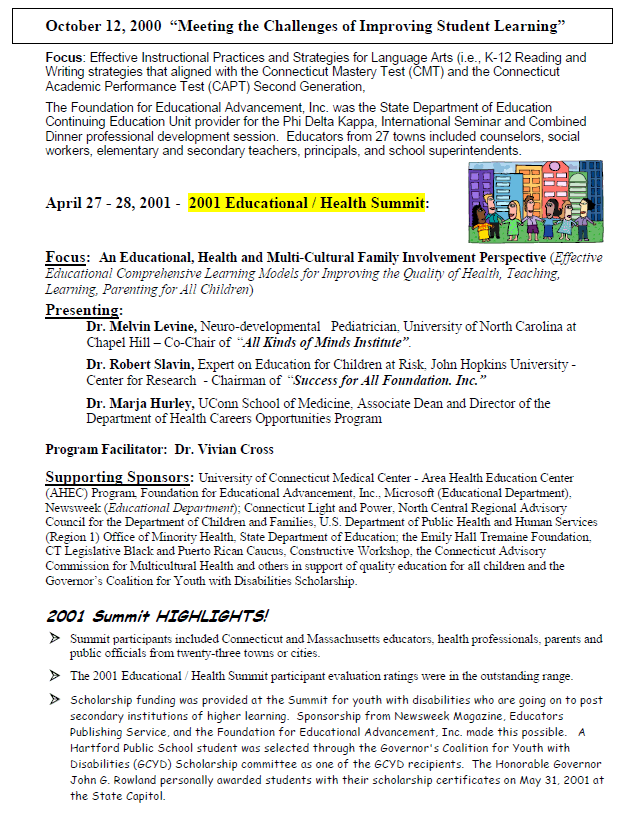
October 12, 2000  “Meeting the Challenges of Improving Student Learning”


Focus: Effective Instructional Practices and Strategies for Language Arts (i.e., K-12 Reading and Writing strategies that aligned with the Connecticut Mastery Test (CMT) and the Connecticut Academic Performance Test (CAPT) Second Generation,

The Foundation for Educational Advancement, Inc. was the State Department of Education Continuing Education Unit provider for the Phi Delta Kappa, International Seminar and Combined Dinner professional development session.  Educators from 27 towns included counselors, social workers, elementary and secondary teachers, principals, and school superintendents.


April 27 - 28, 2001 -  2001 Educational / Health Summit
Focus:An Educational, Health and Multi-Cultural Family Involvement Perspective (Effective Educational Comprehensive Learning Models for Improving the Quality of Health, Teaching, Learning, Parenting for All Children)

Presenting:
Dr. Melvin Levine, Neuro-developmental   Pediatrician, University of North Carolina at Chapel Hill – Co-Chair of  “All Kinds of Minds Institute”.

Dr. Robert Slavin, Expert on Education for Children at Risk, John Hopkins University - Center for Research  - Chairman of  “Success for All Foundation. Inc.”

Dr. Marja Hurley, UConn School of Medicine, Associate Dean and Director of the Department of Health Careers Opportunities Program

Program Facilitator:  Dr. Vivian Cross

Supporting Sponsors: University of Connecticut Medical Center - Area Health Education Center (AHEC) Program, Foundation for Educational Advancement, Inc., Microsoft (Educational Department), Newsweek (Educational Department); Connecticut Light and Power, North Central Regional Advisory Council for the Department of Children and Families, U.S. Department of Public Health and Human Services (Region 1) Office of Minority Health, State Department of Education; the Emily Hall Tremaine Foundation, CT Legislative Black and Puerto Rican Caucus, Constructive Workshop, the Connecticut Advisory Commission for Multicultural Health and others in support of quality education for all children and the Governor’s Coalition for Youth with Disabilities Scholarship.    
 
2001 Summit HIGHLIGHTS!

  • Summit participants included Connecticut and Massachusetts educators, health professionals, parents and public officials from twenty-three towns or cities.


  • The 2001 Educational / Health Summit participant evaluation ratings were in the outstanding range.


  • Scholarship funding was provided at the Summit for youth with disabilities who are going on to post secondary institutions of higher learning.  Sponsorship from Newsweek Magazine, Educators Publishing Service, and the Foundation for Educational Advancement, Inc. made this possible.   A Hartford Public School student was selected through the Governor's Coalition for Youth with Disabilities (GCYD) Scholarship committee as one of the GCYD recipients.  The Honorable Governor John G. Rowland personally awarded students with their scholarship certificates on May 31, 2001 at the State Capitol.


  • Parents and educators from the Hartford area, Waterbury, and the Meriden Public Schools received corporate and foundation registration sponsorships from C L & P and the Emily Hall Tremaine Foundation.


  • The “Hearts A’ Fire YOUTH CHOIR” comprised of 45 middle school through college students from nine Connecticut towns or school districts were outstanding.  They wrote and produced “A Brighter Day”, an inspirational musical selection and dedicated it to educators, parents, health professionals and other care providers at the summit.


  • Continuing Education credits were provided to educators, social workers, school psychologists, guidance counselors, registered nurses and other educational and health professionals.   In addition, Continuing Medical Education (CME) credits were offered to physicians through the University of Connecticut Health Center, AHEC and FEA.   The Foundation for Educational Advancement, Inc. is an approved Continuing Education provider by the State Department of Education and the Connecticut Nurses Association (CNA).


  • Microsoft software was provided for educators and parents.  Summit participant teams from Waterbury, Meriden, Hartford, Manchester, etc., were provided software that included Microsoft Office XP 2002, Microsoft Office 2000 "Premium" or the Multi-Language Microsoft 2000 software to address diversity needs in language.   "Spring 2001 Microsoft Accessibility" (Technology for Everyone) software was also provided for summit participants courtesy of Microsoft Corporation.


  • Teams of participants will be following through with a number of educational and health projects that were initiated, developed and / or established during the summit.


  • Special thanks to sponsors such as Newsweek Magazine, CL&P, UConn (AHEC), the Foundation for Educational Advancement, Inc., the Tramaine Foundation, the CT Legislative Black and Puerto Rican Caucus, Educators Publishing Service, CTnow.com, Constructive Workshop, CHET and HUSKY programs, etc., and many others who provided resources and support for the benefit of children and families.


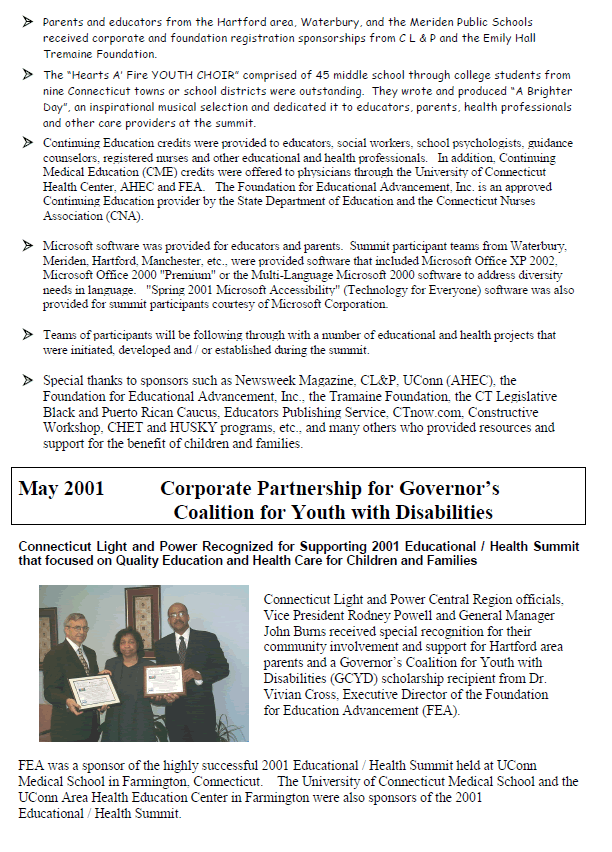
May 2001  Corporate Partnership for Governor’s Coalition for Youth with Disabilities

Connecticut Light and Power Recognized for Supporting 2001 Educational / Health Summit that focused on Quality Education and Health Care for Children and Families.

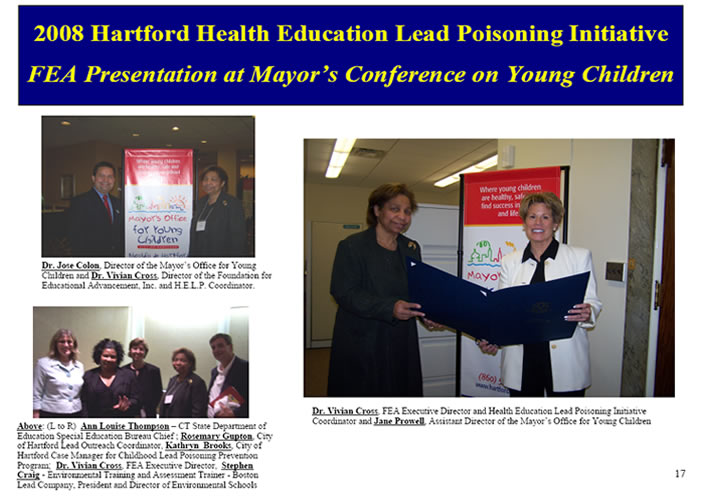
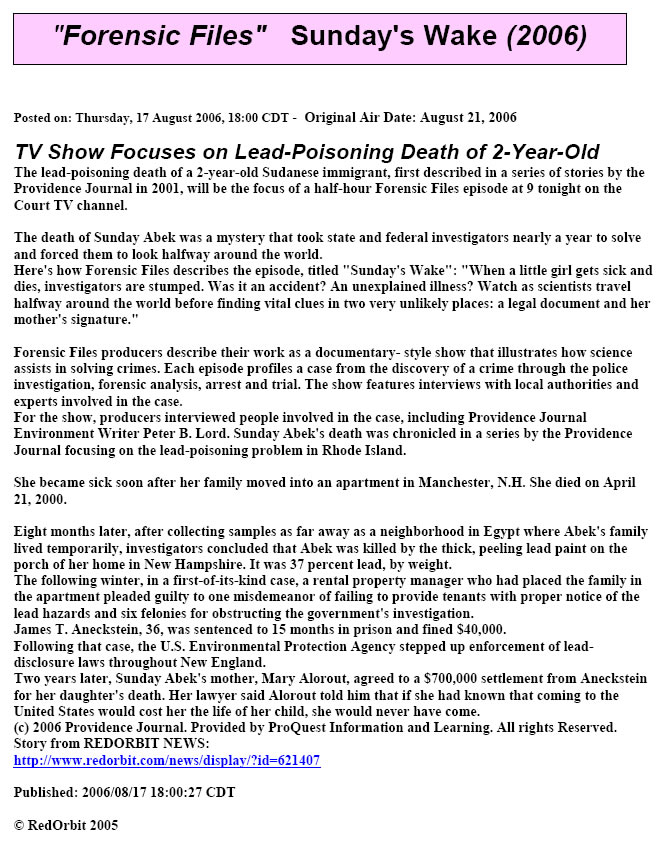
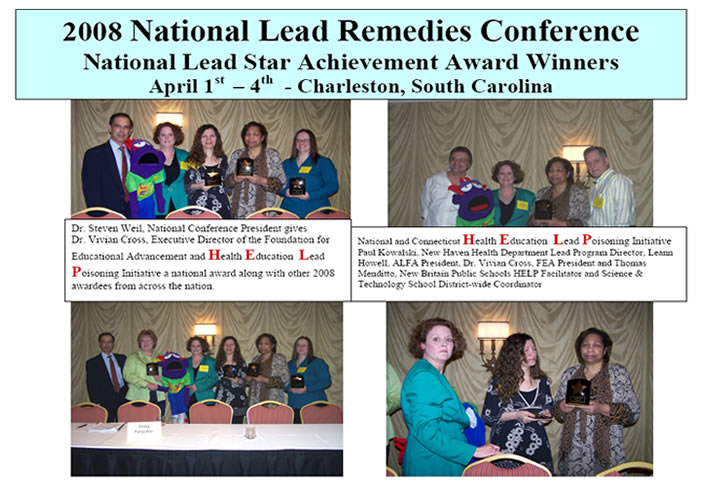
Connecticut Light and Power Central Region officials, Vice President Rodney Powell and General Manager John Burns received special recognition for their community involvement and support for Hartford area parents and a Governor’s Coalition for Youth with Disabilities (GCYD) scholarship recipient from Dr. Vivian Cross, Executive Director of the Foundation for Education Advancement (FEA).   

FEA was a sponsor of the highly successful 2001 Educational / Health Summit held at UConn Medical School in Farmington, Connecticut.    The University of Connecticut Medical School and the UConn Area Health Education Center in Farmington were also sponsors of the 2001
Educational / Health Summit.


2001 through 2003- GCYD SCHOLARSHIP AWARDS


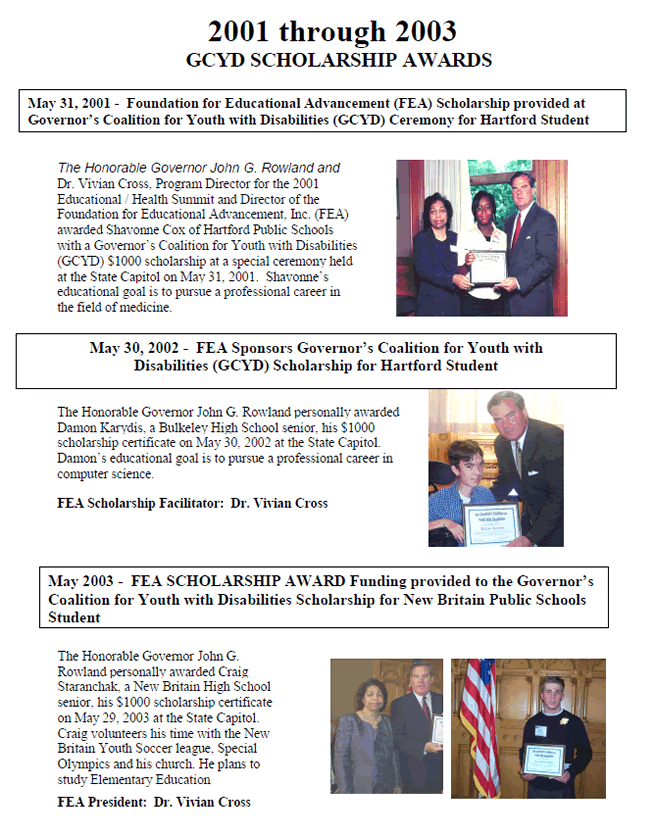
May 31, 2001 - Foundation for Educational Advancement (FEA) Scholarship provided at Governor’s Coalition for Youth with Disabilities (GCYD) Ceremony for Hartford Student


The Honorable Governor John G. Rowland and Dr. Vivian Cross, Program Director for the 2001 Educational / Health Summit and Director of the Foundation for Educational Advancement, Inc. (FEA) at the State Capitol on May 31, 2001.  Shavonne’s awarded Shavonne Cox of Hartford Public Schools with a Governor’s Coalition for Youth with Disabilities (GCYD) $1000 scholarship at a special ceremony held educational goal is to pursue a professional career in the field of medicine. 


May 30, 2002 -  FEA Sponsors Governor’s Coalition for Youth with Disabilities (GCYD) Scholarship for Hartford Student


The Honorable Governor John G. Rowland personally awarded Damon Karydis, a Bulkeley High School senior, his $1000 scholarship certificate on May 30, 2002 at the State Capitol.  Damon’s educational goal is to pursue a professional career in
computer science.  

May 2003 -  FEA SCHOLARSHIP AWARD Funding provided to the Governor’s Coalition for Youth with Disabilities Scholarship for New Britain Public Schools Student


The Honorable Governor John G. Rowland personally awarded Craig Staranchak, a New Britain High School senior, his $1000 scholarship certificate on May 29, 2003 at the State Capitol.  Craig volunteers his time with the New Britain Youth Soccer league, Special Olympics and his church. He plans to study Elementary Education.


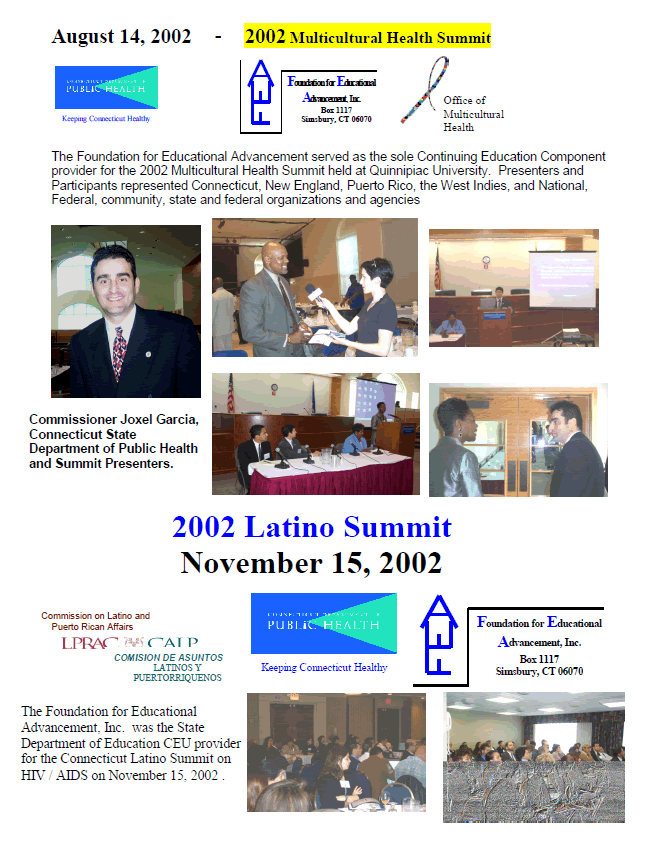
August 14, 2002- 2002 Multicultural Health Summit

The Foundation for Educational Advancement served as the sole Continuing Education component provider for the 2002 Multicultural Health Summit held at Quinnipiac University.  Presenters and Participants represented Connecticut, New England, Puerto Rico, the West Indies, and national, community, state and federal organizations and agencies.

Dr. Joxel Garcia, Commissioner of theConnecticut Department of Public Health

National, Regional and State Summit Presenters 


2002 Latino Summit November 15, 2002
The Foundation for Educational Advancement, Inc.  was the State Department of Education CEU provider for the Connecticut Latino Summit on HIV / AIDS on November 15, 2002


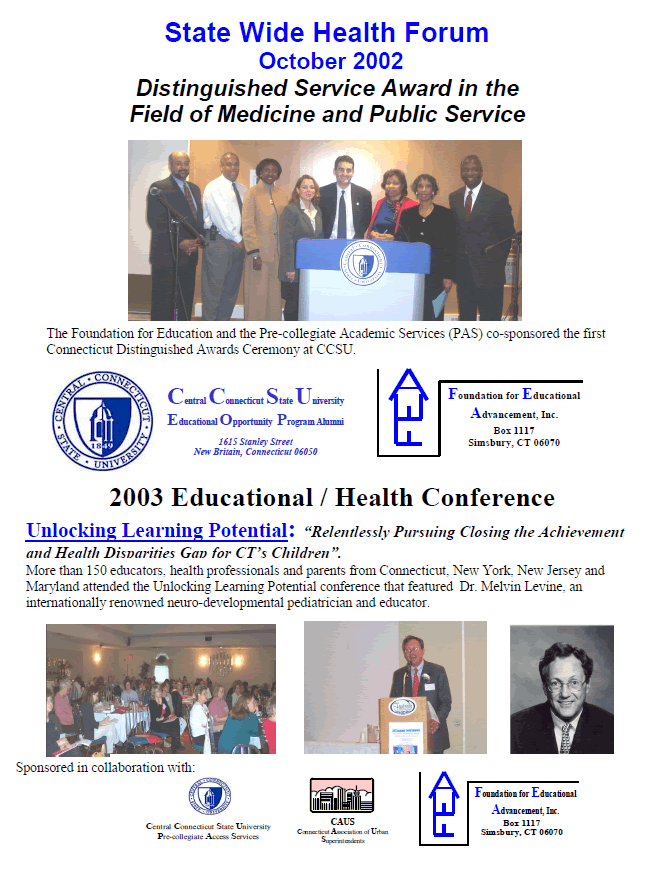
State wide Health Forum- October 2002- Distinguished Service Award in the Field of Medicine and Public Service


The Foundation for Education and the Pre-collegate Academic Services (PAS) co-sponsored the first Connecticut Distinguished Awards Ceremony at CCSU. 


2003 Educational / Health Conference


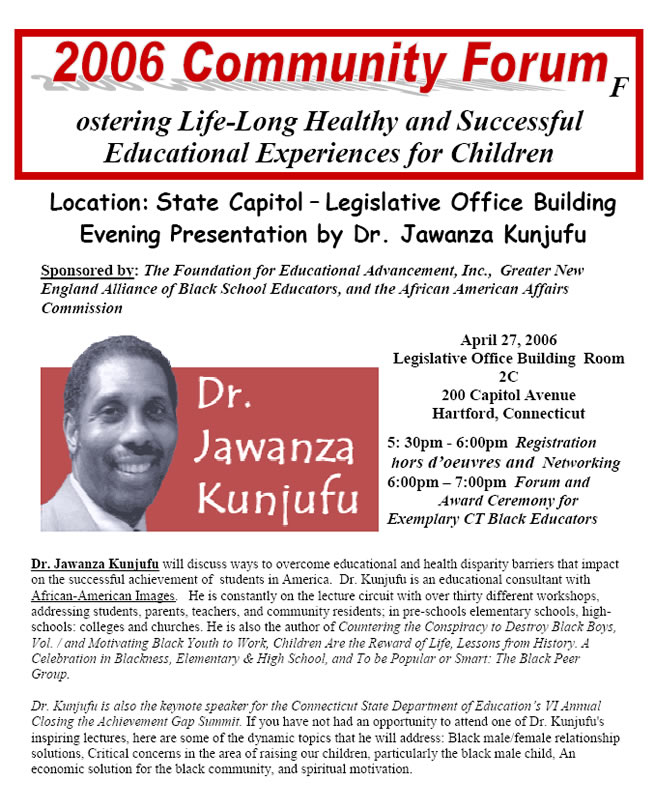
Unlocking Learning Potential: “Relentlessly Pursuing Closing the Achievement and Health Disparities Gap for CT’s Children”.

More than 150 educators, health professionals and parents from Connecticut, New York, New Jersey and Maryland attended the Unlocking Learning Potential conference that featured  Dr. Melvin Levine, an internationally renowned neuro-developmental pediatrician and educator.


Sponsored in Collaboration with:

  • CCSU Pre- collegiate Access Services
  • Connecticut Association of Urban Superintendents
  • Foundation for Educational Advancement, inc.
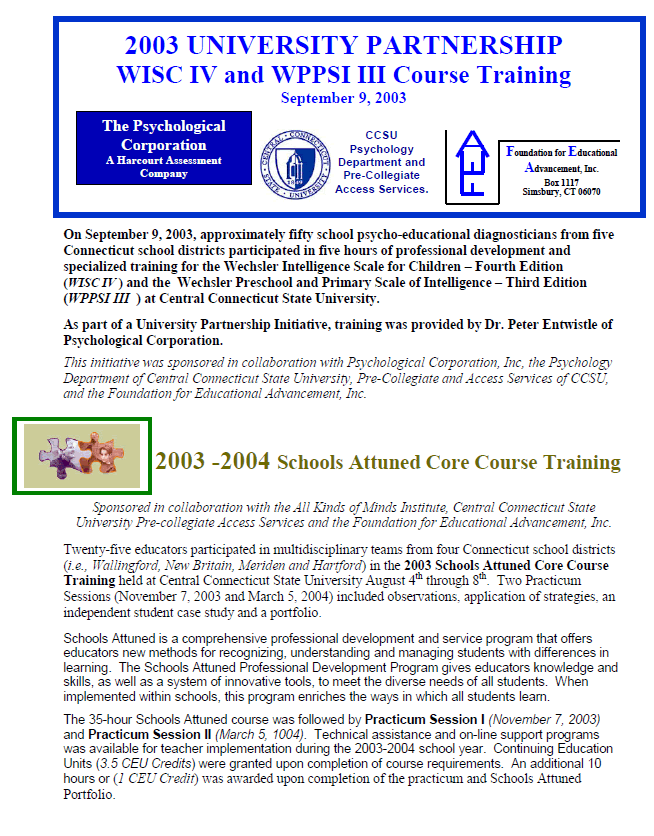
2003 UNIVERSITY PARTNERSHIP WISC IV and WPPSI III Course Training September 9, 2003

On September 9, 2003, approximately fifty school psycho-educational diagnosticians from five Connecticut school districts participated in five hours of professional development and specialized training for the Wechsler Intelligence Scale for Children – Fourth Edition

(WISC IV ) and the  Wechsler Preschool and Primary Scale of Intelligence – Third Edition (WPPSI III  ) at Central Connecticut State University.

As part of a University Partnership Initiative, training was provided by Dr. Peter Entwistle of Psychological Corporation. 

This initiative was sponsored in collaboration with Psychological Corporation, Inc, the Psychology Department of Cetral connecticut State University, Pre-Collegiate and Access Services of CCSU, and the Foundation for Educational Advancement, Inc. 

2003 -2004 Schools Attuned Core Course Training


 Sponsored in collaboration with the All Kinds of Minds Institute, Central Connecticut State University Pre-collegiate Access Services and the Foundation for Educational Advancement, Inc.

Twenty-five educators participated in multidisciplinary teams from four Connecticut school districts (i.e., Wallingford, New Britain, Meriden and Hartford) in the 2003 Schools Attuned Core Course Training held at Central Connecticut State University August 4th through 8th.  Two Practicum Sessions (November 7, 2003 and March 5, 2004) included observations, application of strategies, an independent student case study and a portfolio. 

Schools Attuned is a comprehensive professional development and service program that offers educators new methods for recognizing, understanding and managing students with differences in learning.  The Schools Attuned Professional Development Program gives educators knowledge and skills, as well as a system of innovative tools, to meet the diverse needs of all students.  When implemented within schools, this program enriches the ways in which all students learn.   

The 35-hour Schools Attuned course was followed by Practicum Session I (November 7, 2003) and Practicum Session II (March 5, 1004).  Technical assistance and on-line support programs was available for teacher implementation during the 2003-2004 school year.  Continuing Education Units (3.5 CEU Credits) were granted upon completion of course requirements.  An additional 10 hours or (1 CEU Credit) was awarded upon completion of the practicum and Schools Attuned Portfolio. 


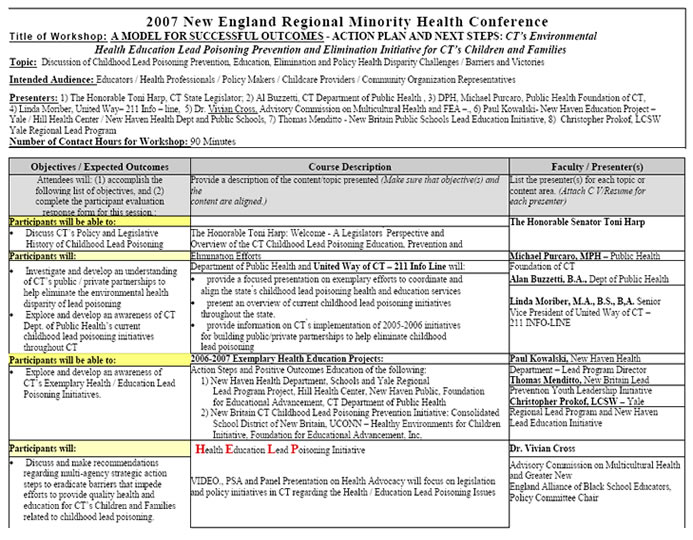
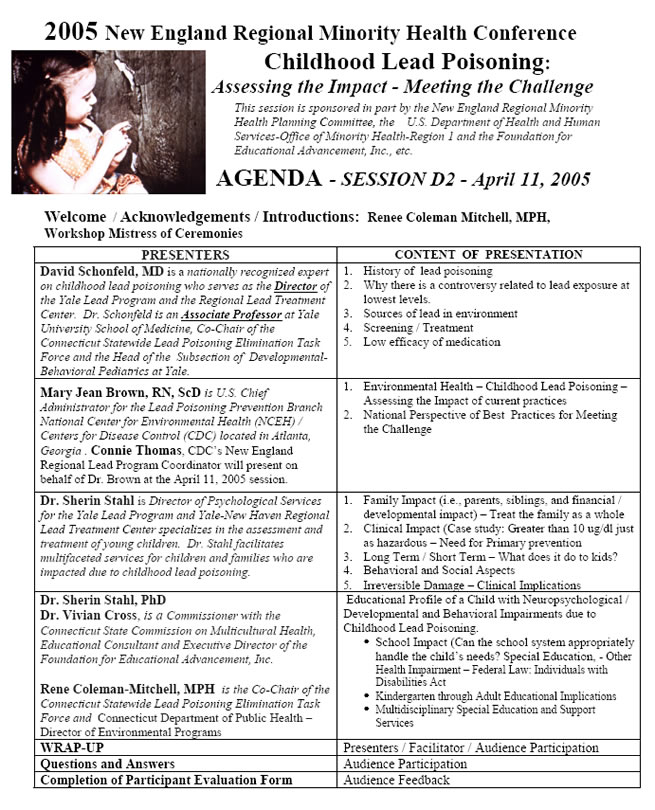
2005 New England Regional Minority Health Conference


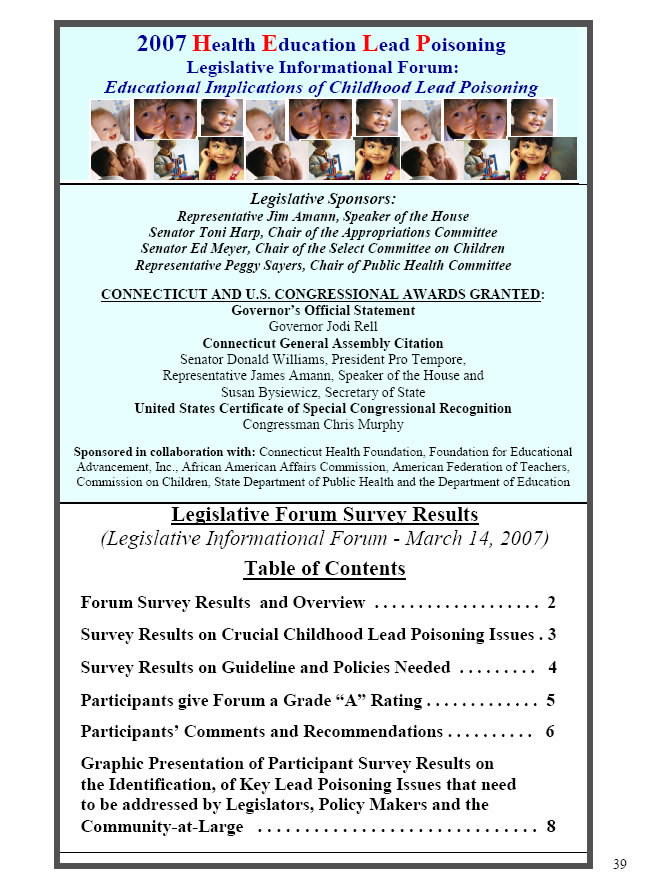
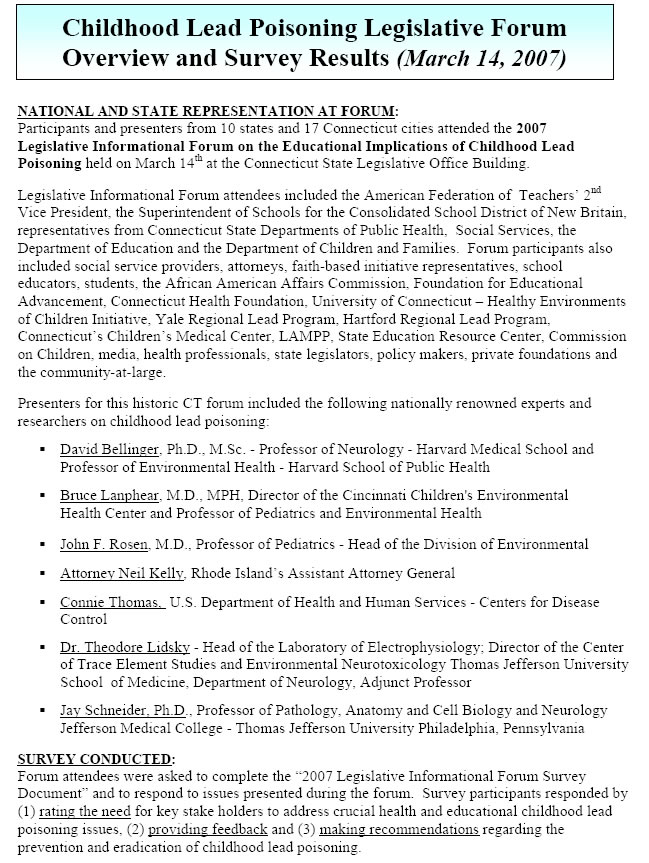
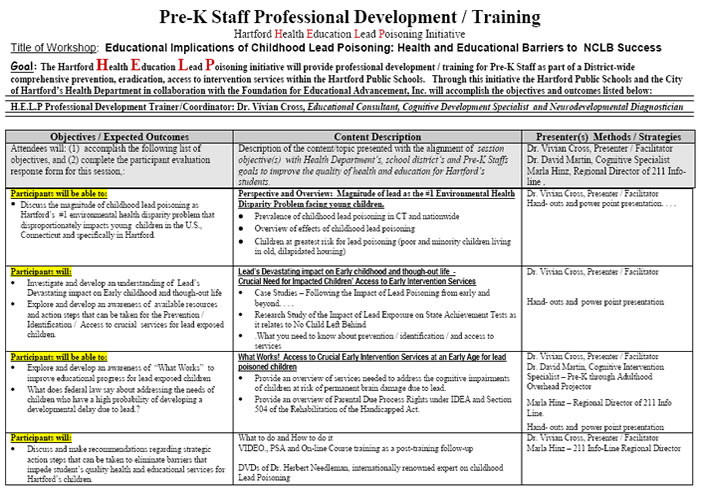
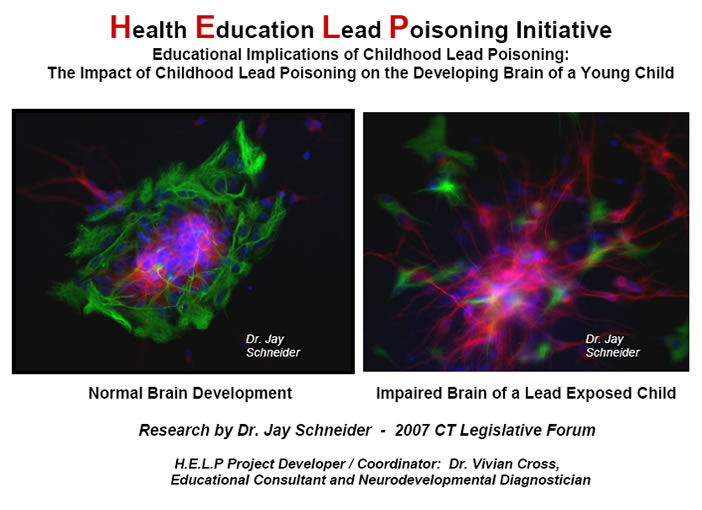
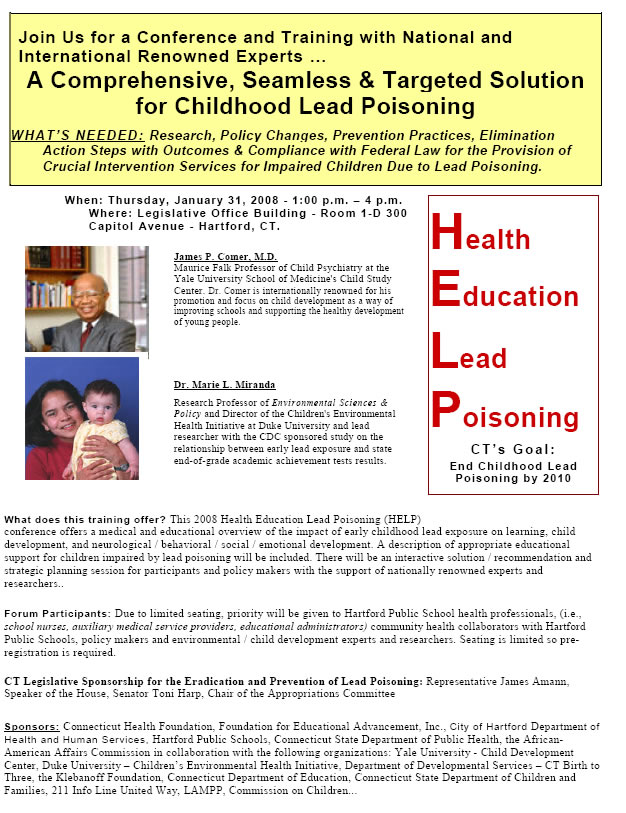
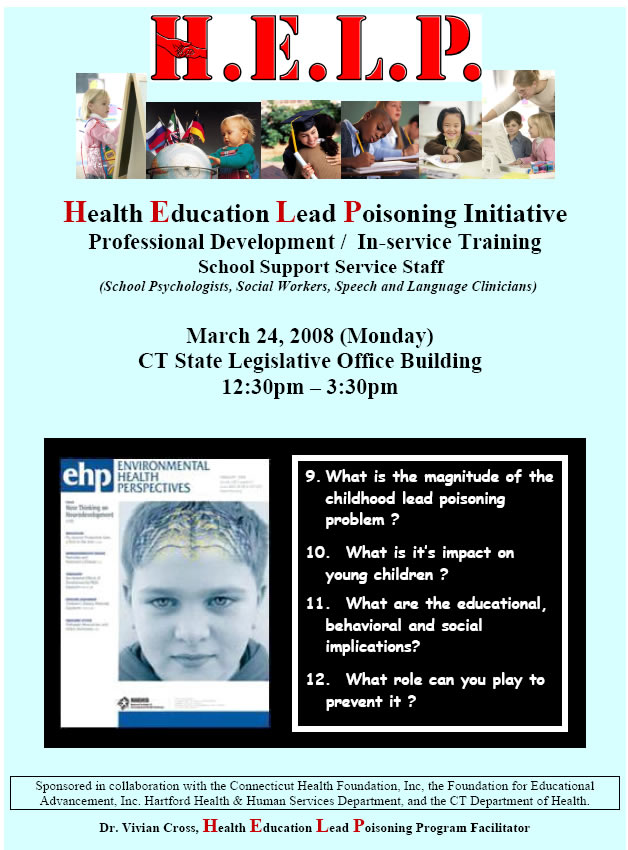
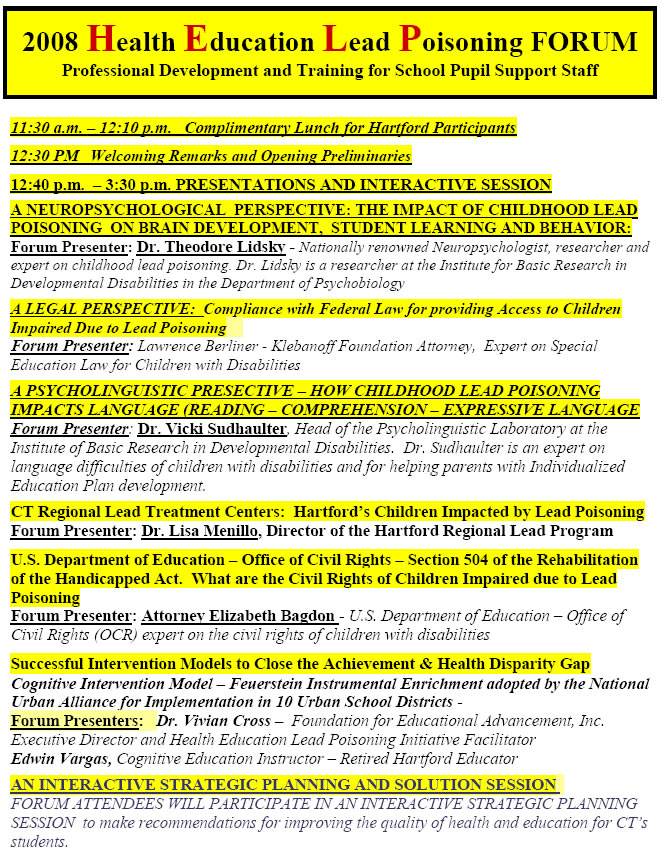
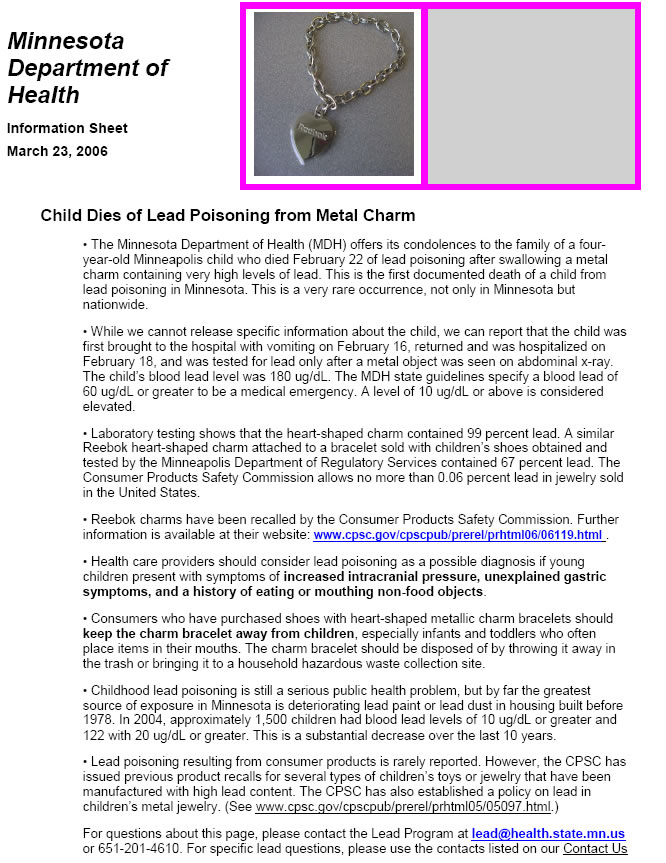
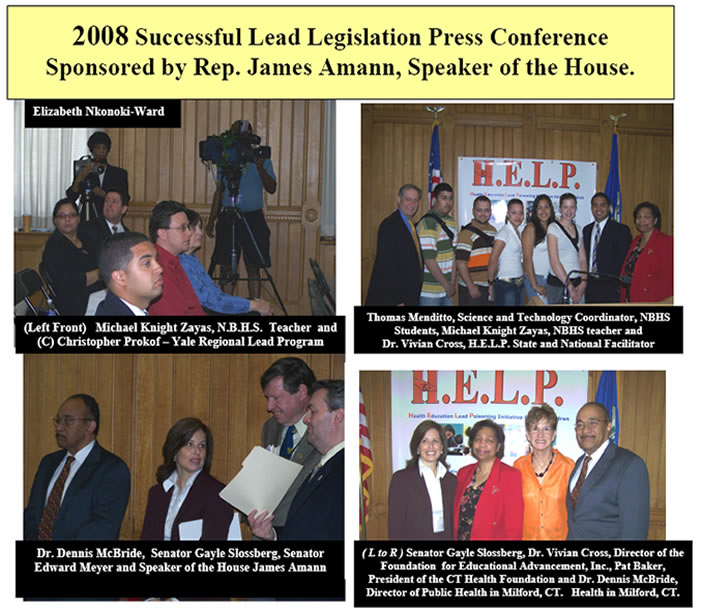
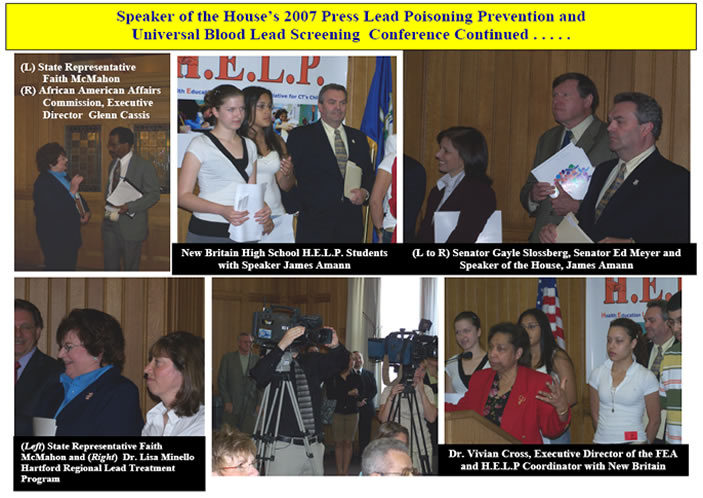
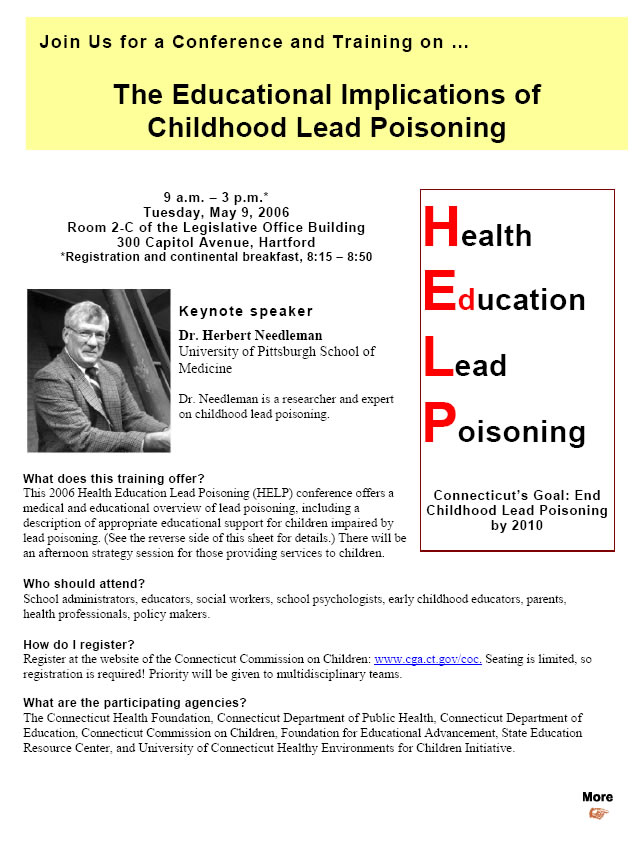
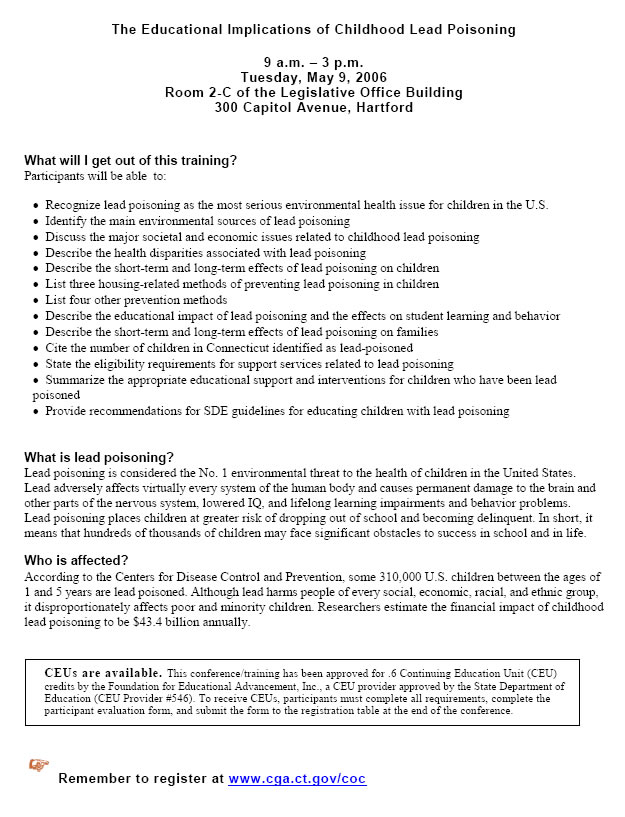
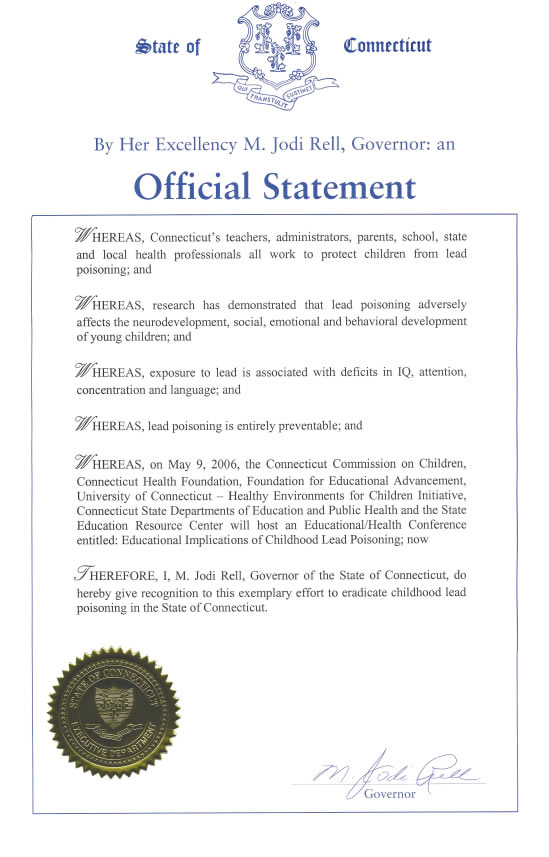
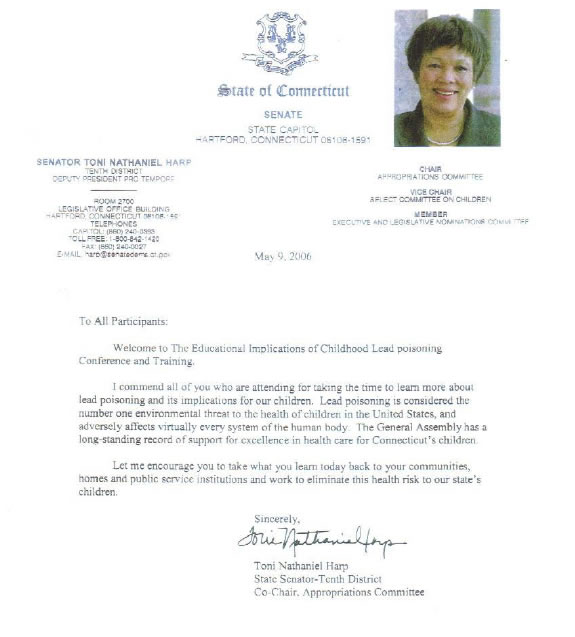
Childhood Lead Poisoning:

Assessing the Impact - Meeting the Challenge  

This session is sponsored in part by the New England Regional Minority Health Planning Committee, the    U.S. Department of Health and Human Services-Office of Minority Health-Region 1 and the Foundation for Educational Advancement, Inc., etc.        

AGENDA - SESSION D2 - April 11, 2005


Welcome  / Acknowledgements / Introductions: Renee Coleman Mitchell, MPH, Workshop Mistress of Ceremonies


PRESENTERS

CONTENT  OF  PRESENTATION

David Schonfeld, MD is a nationally recognized expert on childhood lead poisoning who serves as the Director of the Yale Lead Program and the Regional Lead Treatment Center  Dr. Schonfeld is an Associate Professor at Yale University School of Medicine, Co-Chair of the Connecticut Statewide Lead Poisoning Elimination Task Force and the Head of the  Subsection of  Developmental-Behavioral Pediatrics at Yale.

  1. History of  lead poisoning
  2. Why there is a controversy related to lead exposure at lowest levels.
  3. Sources of lead in environment
  4. Screening / Treatment
  5. Low efficacy of medication

Mary Jean Brown, RN, ScD is U.S. Chief Administrator for the Lead Poisoning Prevention Branch National Center for Environmental Health (NCEH) / Centers for Disease Control (CDC) located in Atlanta, Georgia . Connie Thomas, CDC’s New England Regional Lead Program Coordinator will present on behalf of Dr. Brown at the April 11, 2005 session.

  1. Environmental Health – Childhood Lead Poisoning – Assessing the Impact of current practices
  2. National Perspective of Best  Practices for Meeting the Challenge

Dr. Sherin Stahl is Director of Psychological Services for the Yale Lead Program and Yale- New Haven Regional Lead Treatment Center specializes in the assessment and treatment of young children.  Dr. Stahl facilitates multifaceted services for children and families who are impacted due to childhood lead poisoning.

  1. Family Impact (i.e., parents, siblings, and financial / developmental impact) – Treat the family as a whole
  2. Clinical Impact (Case study: Greater than 10 ug/dl just as hazardous – Need for Primary prevention
  3. Long Term / Short Term – What does it do to kids?
  4. Behavioral and Social Aspects
  5. Irreversible Damage – Clinical Implications

Dr. Sherin Stahl, PhD
Dr. Vivian Cross, is a Commissioner with the Connecticut State Commission on Multicultural Health, Educational Consultant and Executive Director of the Foundation for Educational Advancement, Inc.

Rene Coleman-Mitchell, MPH  is the Co-Chair of the Connecticut Statewide Lead Poisoning Elimination Task Force and  Connecticut Department of Public Health – Director of Environmental Programs

 Educational Profile of a Child with Neuropsychological / Developmental and Behavioral Impairments due to Childhood Lead Poisoning.

  1. School Impact (Can the school system appropriately handle the child’s needs? Special Education, - Other Health Impairment – Federal Law: Individuals with Disabilities Act
  2. Kindergarten through Adult Educational Implications
  3. Multidisciplinary Special Education and Support Services

WRAP-UP

Presenters / Facilitator / Audience Participation

Questions and Answers

Audience Participation

Completion of Participant Evaluation Form

Audience Feedback


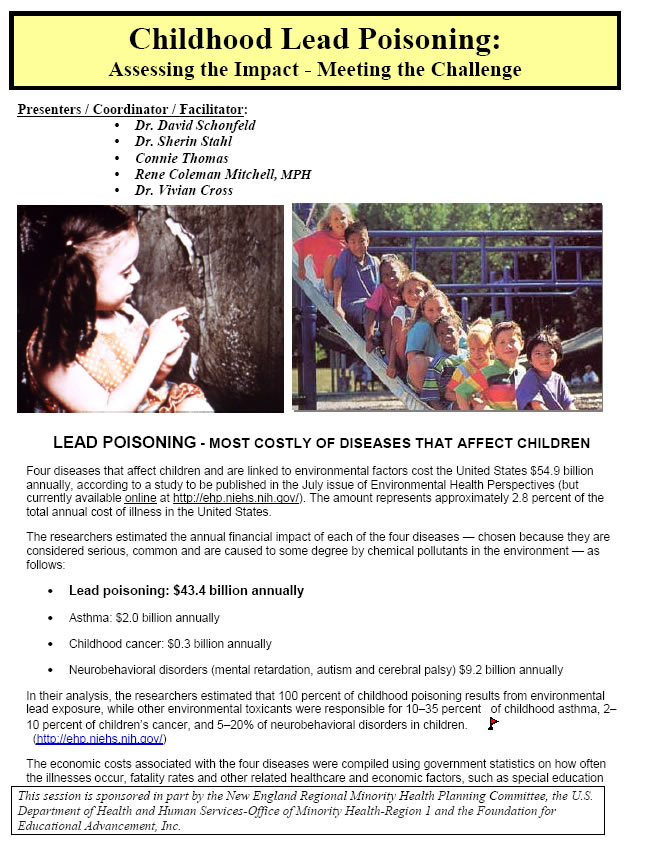
LEAD POISONING - MOST COSTLY OF DISEASES THAT AFFECT CHILDREN


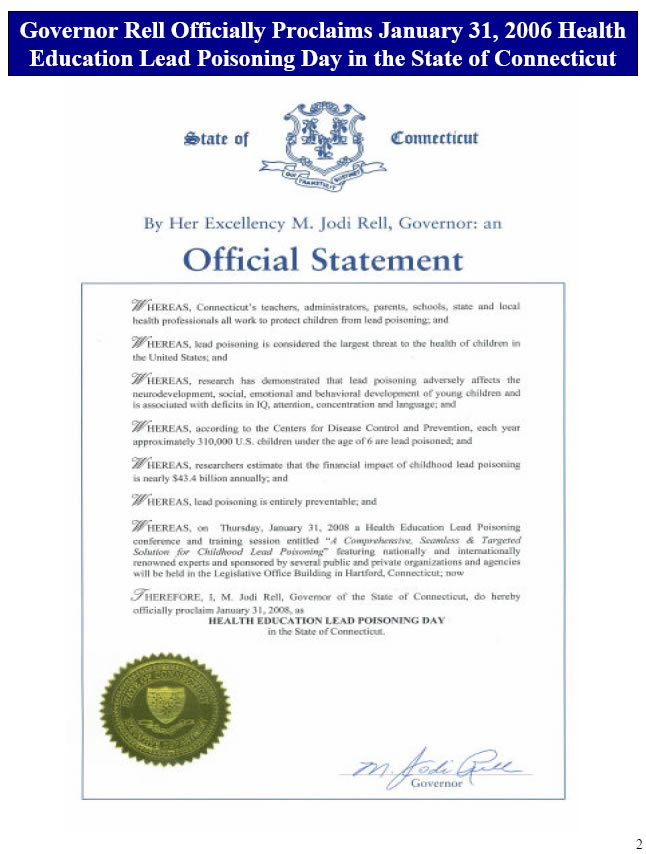
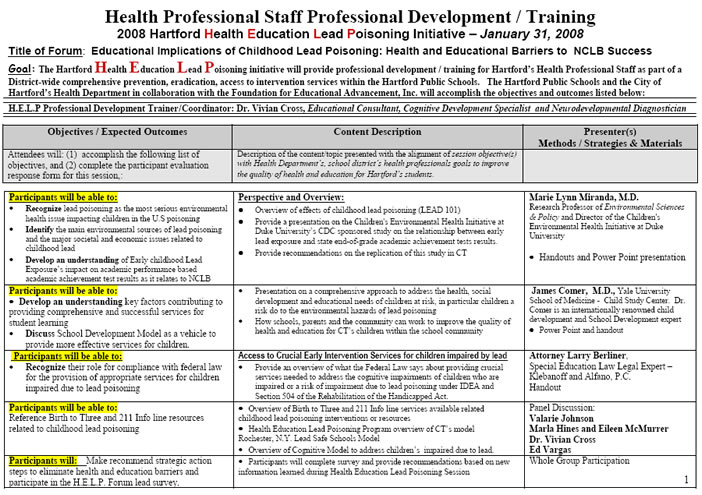
Four diseases that affect children and are linked to environmental factors cost the United States $54.9 billion annually, according to a study to be published in the July issue of Environmental Health Perspectives (but currently available online at http://ehp.niehs.nih.gov/). The amount represents approximately 2.8 percent of the total annual cost of illness in the United States.
The researchers estimated the annual financial impact of each of the four diseases — chosen because they are considered serious, common and are caused to some degree by chemical pollutants in the environment — as follows:

  • Lead poisoning: $43.4 billion annually
  • Asthma: $2.0 billion annually
  • Childhood cancer: $0.3 billion annually
  • Neurobehavioral disorders (mental retardation, autism and cerebral palsy) $9.2 billion annually

In their analysis, the researchers estimated that 100 percent of childhood poisoning results from environmental lead exposure, while other environmental toxicants were responsible for 10–35 percent   of childhood asthma, 2–10 percent of children’s cancer, and 5–20% of neurobehavioral disorders in children.      (http://ehp.niehs.nih.gov/)

The economic costs associated with the four diseases were compiled using government statistics on how often the illnesses occur, fatality rates and other related healthcare and economic factors, such as special education

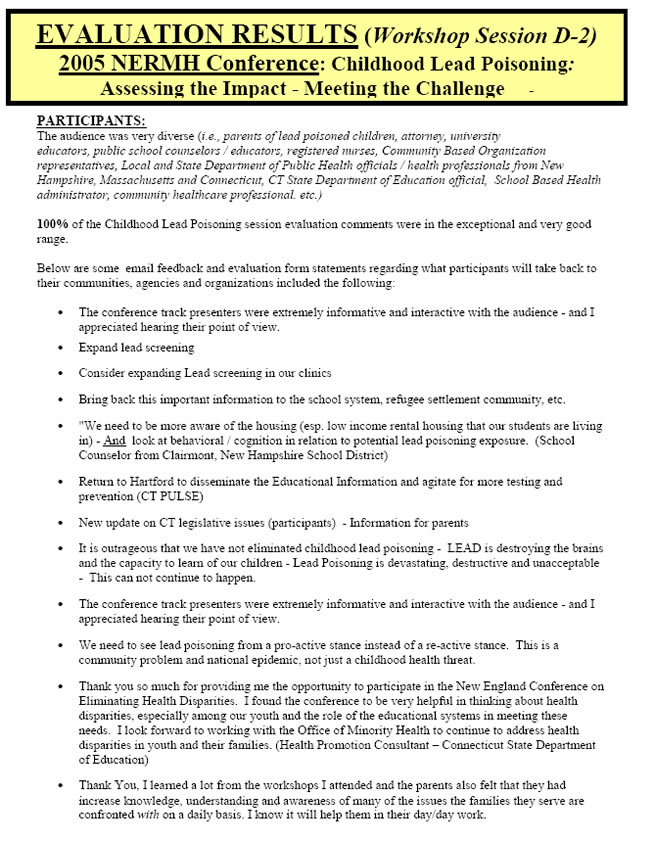
EVALUATION RESULTS (Workshop Session D-2)
   Childhood Lead Poisoning:


PARTICIPANTS:
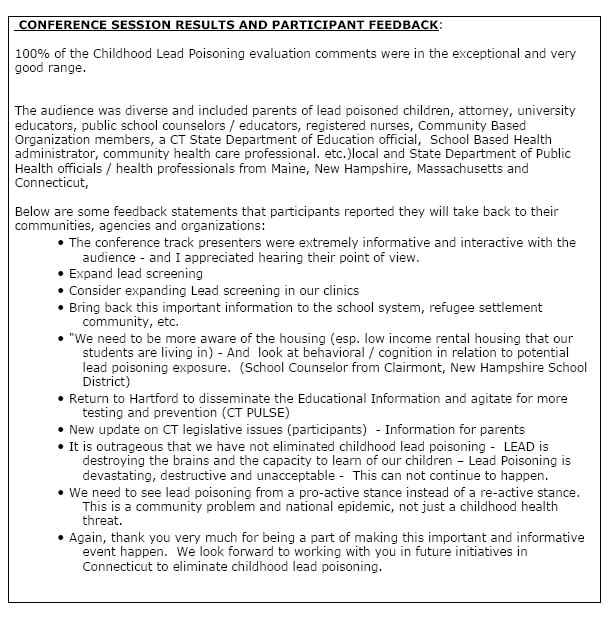
The audience was very diverse (i.e., parents of lead poisoned children, attorney, university educators, public school counselors / educators, registered nurses, Community Based Organization representatives, Local and State Department of Public Health officials / health professionals from New Hampshire, Massachusetts and Connecticut, CT State Department of Education official,  School Based Health administrator, community healthcare professional. etc.)  

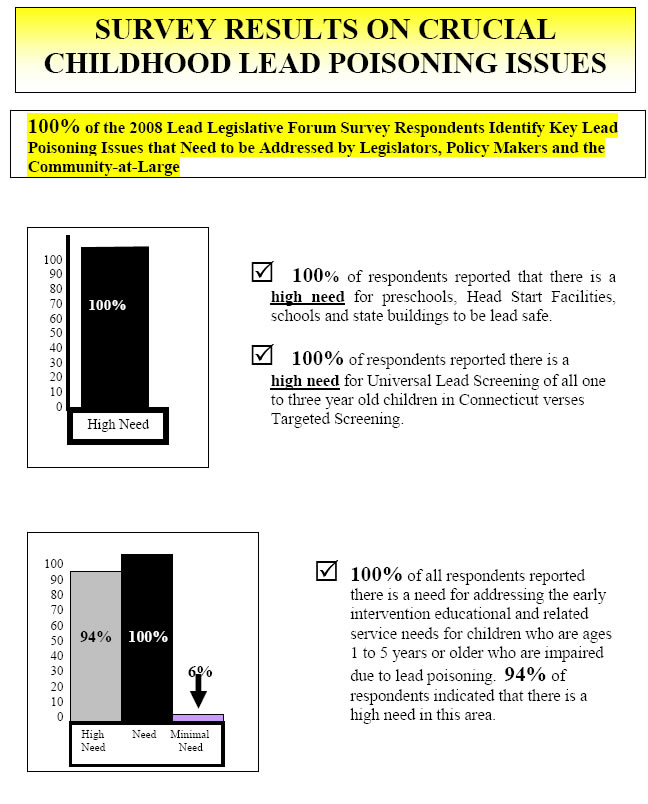
100% of the Childhood Lead Poisoning session evaluation comments were in the exceptional and very good range.  Below are some  email feedback and evaluation form statements regarding what participants will take back to their communities, agencies and organizations included the following: The conference track presenters were extremely informative and interactive with the audience - and I appreciated hearing their point of view.
  • Expand lead screening


  • Consider expanding Lead screening in our clinics 


  • Bring back this important information to the school system, refugee settlement community, etc. 


  • "We need to be more aware of the housing (esp. low income rental housing that our students are living in) - And  look at behavioral / cognition in relation to potential lead poisoning exposure.  (School Counselor from Clairmont, New Hampshire School District)


  • Return to Hartford to disseminate the Educational Information and agitate for more testing and prevention (CT PULSE)


  • New update on CT legislative issues (participants)  - Information for parents


  • It is outrageous that we have not eliminated childhood lead poisoning -  LEAD is destroying the brains and the capacity to learn of our children - Lead Poisoning is devastating, destructive and unacceptable -  This can not continue to happen.


  • The conference track presenters were extremely informative and interactive with the audience - and I appreciated hearing their point of view.


  • We need to see lead poisoning from a pro-active stance instead of a re-active stance.  This is a community problem and national epidemic, not just a childhood health threat.


  • Thank you so much for providing me the opportunity to participate in the New England Conference on Eliminating Health Disparities.  I found the conference to be very helpful in thinking about health disparities, especially among our youth and the role of the educational systems in meeting these needs.  I look forward to working with the Office of Minority Health to continue to address health disparities in youth and their families. (Health Promotion Consultant – Connecticut State Department of Education)


  • Thank You, I learned a lot from the workshops I attended and the parents also felt that they had increase knowledge, understanding and awareness of many of the issues the families they serve are confronted with on a daily basis. I know it will help them in their day/day work.

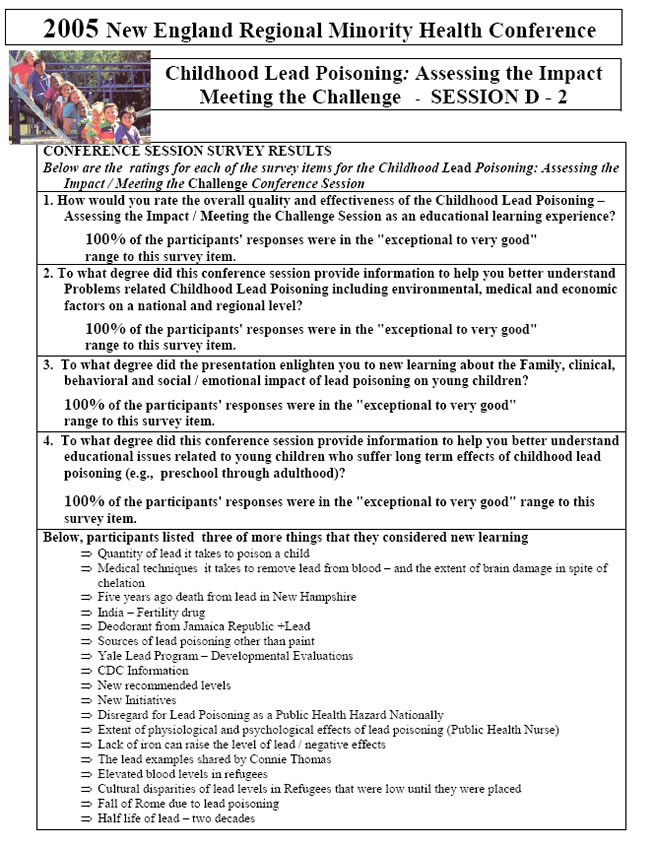
2005 New England Regional Minority Health Conference


 Evaluation Form Instructions:

Please answer the following questions and submit the completed form at the end of the Childhood Lead Poisoning – Assessing the Impact / Meeting the Challenge Session to the facilitator:


Participant Response Questions

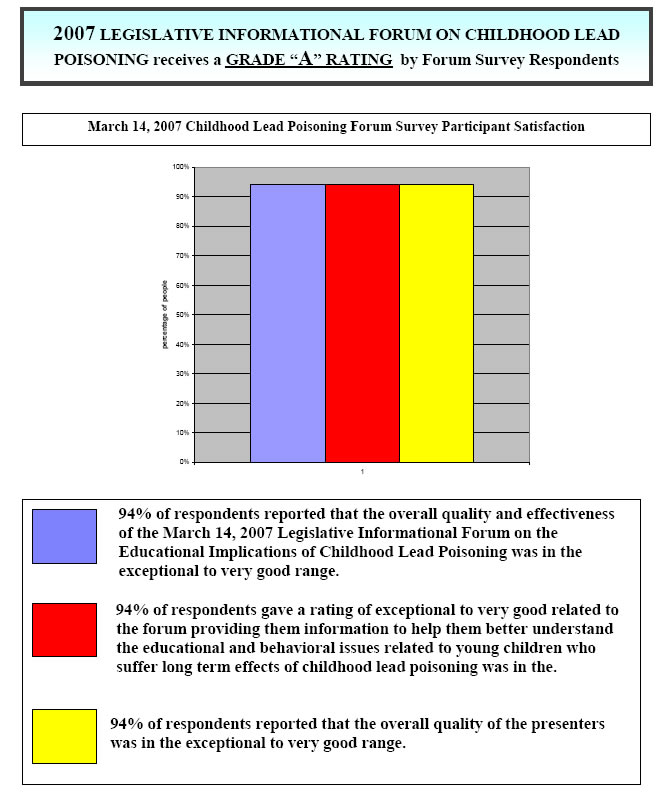
  • How would you rate the overall quality and effectiveness of the Childhood Lead Poisoning – Assessing the Impact / Meeting the Challenge Session as an educational learning experience?

     Exceptional  -    Very  Good range = 100

2. To what degree did this conference session provide information to help you better understand Problems related Childhood Lead Poisoning including environmental, medical and economic factors on a national and regional level?
Exceptional  -    Very  Good range = 100%


3.  To what degree did the presentation enlighten you to new learning about the Family, clinical, behavioral and social / emotional impact of lead poisoning on young children?
Exceptional  -    Very  Good range = 100%      

4.  To what degree did this conference session provide information to help you better understand educational issues related to young children who suffer long term effects of childhood lead poisoning (e.g.,  preschool through adulthood)?
Exceptional  -    Very  Good range = 100%      

  • List three or more things that you consider new learning
  • Quantity of lead it takes to poison a child
  • Medical techniques  it takes to remove lead from blood – and the extent of brain damage in spite of chelation
  • Five years ago death from lead in New Hampshire
  • India – Fertility drug
  • Deodorant from Jamaica Republic +Lead
  • Sources of lead poisoning other than paint
  • Yale Lead Program – Developmental Evaluations
  • CDC Information
  • New recommended levels
  • New Initiatives
  • Disregard for Lead Poisoning as a Public Health Hazard Nationally
  • Extent of physiological and psychological effects of lead poisoning (Public Health Nurse)
  • Lack of iron can raise the level of lead / negative effects
  • The lead examples shared by Connie Thomas
  • Elevated blood levels in refugees
  • Cultural disparities of lead levels in Refugees that were low until they were placed
  • Fall of Rome due to lead poisoning
  • Half life of lead – two decades


Return to top

© 2008 Foundation for Educational Advancement, Inc. of Connecticut